The adult amateur equestrian is the sport's highest-spending, most financially independent, and most systematically ignored customer segment. I know this as a 20-year consumer marketing and e-commerce professional. I know it more personally as someone who returned to riding after 25 years away and found an industry that had not thought very hard about people like me.
At 10 a.m. sharp last summer, I was ready.
Forms filled out. Credit card saved. Filters pre-selected. Cursor hovering over the registration button for my daughter's summer camp, the one that books out in minutes every year without fail.
I have spent the better part of the last decade running like this. Ready at 10 a.m. for everyone else. My kids, my stepfather, my employer, the Medicaid paperwork that does not care what else is on your plate. After my mother died of breast cancer in 2023, I became the primary support system for my aging stepfather. I relocated him, navigated assisted living applications, and absorbed the full weight of being an only child responsible for parents who had not planned for the end. All while working a full-time corporate career and raising two children who still needed lunch made and permission slips signed.
I am what researchers call the sandwich generation. I call it not enough hours and never enough of yourself left at the end of the day.
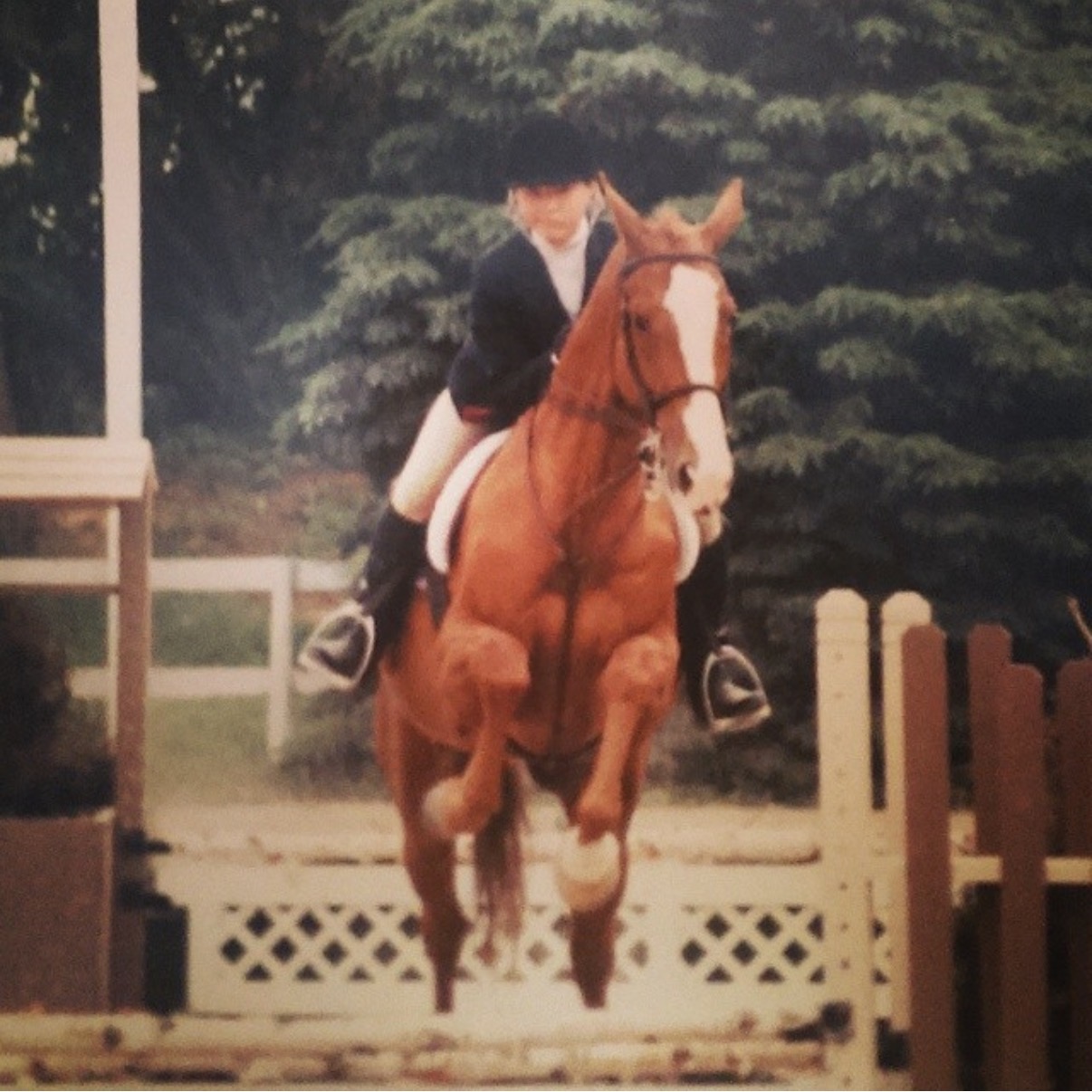
For 25 years, I did not ride. I had ridden seriously as a kid: an off-track Thoroughbred named Justin, regional B circuit shows in the Chicagoland area, four years that felt like a whole lifetime and turned out to be exactly four years before I burned out and walked away like most teenagers do. I trail rode occasionally, stayed connected to horses at the edges of my life. But the sport itself was gone.
Coming back was not a spontaneous decision. It was a reckoning.
At some point in the middle of all that caregiving, I realized that a life run entirely on logistics is not actually a life. For Christmas I asked my husband for a six-pack of riding lessons. I told myself it would be a casual weekly hobby.
I am not a casual person. Two months later I was riding three times a week on a half-lease with a 17.3-hand Selle Francais named Beau, a horse who communicates his opinions about unclear contact in terms that leave no room for interpretation.
Full send, as they say.
The Return
What Returning to Riding as an Adult Amateur Actually Looks Like
I came back to this sport with something I did not have the first time around: money, time I had actively carved out, and twenty-plus years of professional experience in digital marketing and e-commerce. I knew what good looked like. I knew what it felt like to be a well-served customer. I knew the difference between a brand that understood me and one that was simply tolerating my presence.
The equestrian industry, by and large, is tolerating my presence.
Not maliciously. Not consciously, even. But the gap between what I am as a customer and how I am treated as one is wide enough to ride a horse through, and I am not the only adult amateur equestrian who has noticed it.
Here is what the data says about people like me, if the industry bothered to look.
The median age of horse owners in the United States is 38. The highest concentration of horse owners falls in the 45 to 59 age bracket. According to American Horse Council data, fifty percent of all horse owners earn over $100,000 annually, and 28% earn $150,000 or more. The typical equestrian household carries a net worth that runs well into seven figures. The average equestrian spends approximately $11,335 per year on horse-related expenses, and that figure does not capture the full picture of what a returning adult amateur actually spends across gear, apparel, lessons, leases, and entry fees.
These are not people who need to be sold on value. They need to be sold on fit: fit for their bodies, their schedules, their skill levels, and their actual lives.
And yet walk into most tack shops, open most equestrian brand websites, scroll through most equestrian marketing, and tell me honestly who that content is for.
It is for the junior. It is for the professional. It is for the aspirational viewer who wants to watch Olympic-level riders from a distance, or the absolute beginner who needs to be told which end of the horse to approach first.
The adult amateur equestrian, the woman who is mid-career, self-funding, and returning to something she loved before life got in the way, is largely invisible.
The Market Gap
The Middle of the Market That Disappeared
There is no middle anymore. That is not hyperbole. That is a structural observation about how the equestrian industry has organized itself.
On one end sits the ultra-elite. Hermes saddle pads. Five-star show coverage. Aspirational content that functions like a documentary about a world most of us will never enter. It is genuinely entertaining to consume. It is functionally irrelevant to my actual purchasing decisions.
On the other end sits the true beginner. Blurry lesson video content. Starter kit guides. Entry-level everything, because the assumption is that anyone new to the sport is also new to the concept of spending money.
The adult amateur equestrian is neither of these people. She returned to the sport as a 40-something professional with disposable income, genuine expertise about what she wants, and often a twenty-year backlog of love for horses that nobody else in her daily life fully understands. She came in ready to spend. She found an industry that had not thought very hard about what she actually needed.
One equestrian marketing consultant captured the problem directly: companies neglecting the 40-plus rider demographic are losing dollars and potential brand champions, because this group has spending power and social influence that drives real revenue, but only if brands speak to them directly. That observation appeared in 2020. The situation has not materially changed.
Three Specific Failures
How the Adult Amateur Equestrian Is Underserved: Three Ways
Underserved is a word that gets applied broadly and means nothing without specifics.
Product design does not account for adult bodies. Breeches are sized and cut for teenagers. Show coats button on the assumption of a body that has never experienced pregnancy or a decade of desk work. Finding well-fitting clothing for a fuller figure remains genuinely difficult in 2026. The complaint that all breeches are cut for juniors is not an aesthetic grievance. It is a functional one. The adult amateur rider is not asking to be flattered. She is asking to ride comfortably and show up at a schooling show without fighting her own waistband.
Equestrian retail UX lags a decade behind the customer's expectations. I work in e-commerce. I think about checkout flows, filtering systems, and user experience design for a living. Equestrian retail, with very few exceptions, is built for a customer who is patient, has time, and does not comparison shop. The adult amateur returning to the sport is none of those things. She is experienced, decisive, and accustomed to being served well by other industries that have figured out how to sell to her. If she cannot filter tall boots by calf width and shaft height simultaneously, she will leave. I left several carts this way, personally.
Equestrian content and community assume you are either a junior or a professional. When I returned to riding and looked for people like me, the content gap was striking. There is a rich universe of material for junior riders. A smaller but solid world for elite professionals. And a vast blank space where the adult amateur equestrian should be: the woman navigating a return to the sport after years away, buying her own gear, making her own decisions, and processing all of it without any framework designed specifically for her. I started making content myself because I could not find it. The response told me everything I needed to know about how hungry this audience is for someone to simply speak to them directly.
The Business Case
Why This Is a Business Problem, Not a Feelings Problem
The adult amateur equestrian is not underserved because no one likes her. She is underserved because the industry has never properly quantified what it is losing by ignoring her.
The conditions that create the returning adult amateur are structural, not individual. A large cohort of riders burned out as teenagers, built careers and families, and now have the means and the motivation to return to horses. They are showing up with real budgets, real opinions, and real expectations shaped by two decades of being well-served in other consumer categories. The brands that recognize this first will earn loyalty that is unusually durable.
Adult women in this demographic share product recommendations within tight barn communities at a rate that other customer segments do not match. When an adult amateur rider finds a brand that fits her body, respects her intelligence, and speaks to her experience honestly, she tells everyone. Barn aisles are efficient word-of-mouth networks. That kind of advocacy cannot be bought with a junior sponsorship.
The brands that do not figure this out will watch the adult amateur continue doing what I have been doing: piecing together a gear kit from wherever she can find something that fits her actual body and her actual life, writing honest reviews because no one else is, and quietly directing her substantial spending toward the brands that bother to deserve it.
The Argument
The Question the Equestrian Industry Needs to Answer
If adult amateur equestrians are the sport's highest-concentration of high-income, high-spending, highly motivated customers, why has the industry not designed for them?
I have a theory. The equestrian industry grew up around the junior, because the junior is visible. She is at the barn every day. Her parents are writing the checks. The show circuit is built around her development. The industry followed the junior because the junior was there, and because junior success stories are the sport's most legible version of itself.
The adult amateur, by contrast, came back quietly. She booked her lessons online. She showed up in the evenings between work and pickup. She bought her gear without asking for help because she was used to figuring things out herself. The industry did not notice her because she did not announce herself.
She is announcing herself now.
The adult amateur equestrian is the sport's best customer: high income, high spending, deeply loyal once she finds a brand that earns it, and actively looking for reasons to stay. The question is which brands will be smart enough to stop overlooking her.
Part 1 (this article): The personal manifesto. The argument that the adult amateur equestrian is the industry's most underserved customer, told through Orchid's own return to riding after 25 years.
Part 2 (coming soon): The market data. A full demographic and spending analysis of the adult amateur segment.
Part 3 (coming soon): The brand opportunity brief. What it would actually take for an equestrian brand to win this customer.