Dover Saddlery is the largest equestrian retailer in the United States. Founded in 1975 by Jim and David Powers, two brothers who had competed on the US Equestrian Team, Dover grew from a single shop in Wellesley, Massachusetts into what the company described as 37 stores and an estimated $158 million in annual revenue. The founding promise was specific: riders selling to riders, a catalog that doubled as a community tool, and a return policy that told customers the company trusted them.
But look at how Dover got here. The company didn't win a competitive market. It survived one where the competition largely eliminated itself. State Line Tack got absorbed and hollowed out. The name still exists as a website, a 1.5-star Trustpilot zombie that takes your money but bears no resemblance to the institution riders once relied on. Regional players couldn't scale. Corporate retail couldn't understand the customer. Dover just had to outlast them, which is a very different thing than beating them.
Dover went public on November 18, 2005, pricing shares at $10 on NASDAQ under the ticker DOVR. The company had targeted $12 to $16 per share, but used a Dutch auction format that let the market set the price instead of letting an investment bank engineer one. The market set it low.
"What is a Dutch auction IPO? In a normal IPO, the investment bank picks the price and decides who gets shares, usually big institutional investors who expect a first-day profit. A Dutch auction skips the gatekeepers. Every buyer submits a bid, and the final price is whatever the market actually thinks the company is worth. Google used one in 2004 to democratize access. Dover used one in 2005 because a niche equestrian retailer was never going to generate Wall Street excitement on a roadshow. The auction was honest. The honesty was not kind."
The public company decade produced steady growth but never a breakout: revenue climbed from roughly $60M to $101.8M between 2005 and 2014, but the stock never sustainably cleared its IPO price. The public market looked at the largest equestrian retailer in the country and said: not worth it.
In 2015, a consortium of three private equity firms, Webster Equity Partners, TriArtisan Capital Advisors, and Promus Equity Partners, took Dover private at $8.50 per share. That is below the IPO price from a decade earlier. The PE consortium bought the discount.
In 2022, Promus took full control of Dover from Webster, with TriArtisan continuing as co-investor. The purchase price was not disclosed. But Promus was not a new buyer walking in cold. They had been a co-owner since 2015. Every decision made since (the franchise program, the debt, the cost cutting, the store closures) is being made by an owner who has been inside this company for over a decade. Promus is not a stranger optimizing something they don't understand. They are a long-term owner who chose to take full control and then hit the gas.
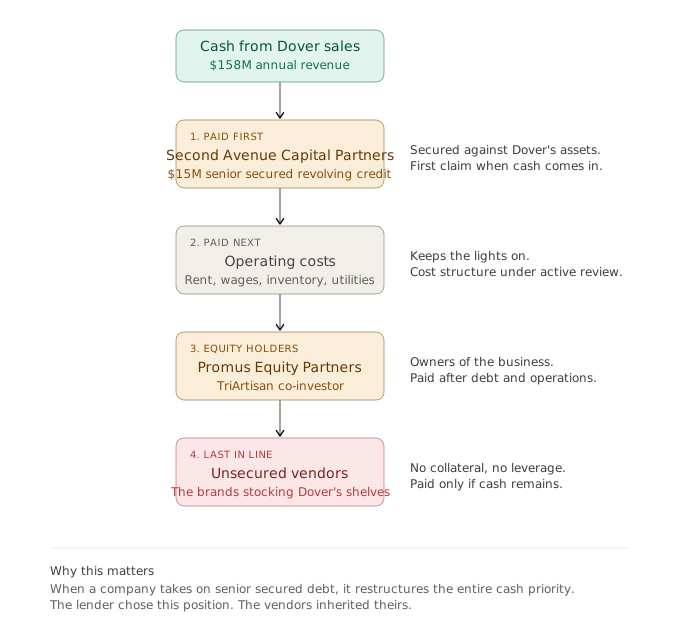
Dover raised an additional $15 million in debt financing from Second Avenue Capital Partners in 2024. The choice of lender matters. Second Avenue Capital Partners is a Schottenstein-affiliated asset-based lender that specializes in retail and consumer companies navigating financial transitions, turnarounds, and restructurings. The $15 million facility is a senior secured revolving credit line, meaning Second Avenue's claim on Dover's assets sits above vendors, unsecured creditors, and the equity holders. When cash comes in, the senior secured lender gets paid first. Everyone else waits.
In 2023, Dover launched a franchise program. Franchising is a classic private equity move: the franchisee puts up the capital, Dover collects the fees. Dover expands without spending its own money, and the margins improve because someone else is carrying the cost. It works in many retail categories. But Dover's competitive moat has always been expertise. The promise of riders selling to riders is hard to put in a franchise operations manual. A franchisee in a new market may not ride. The staff may not ride. The deep product knowledge and community trust that kept Dover alive when everyone else quit is exactly what a franchise model cannot reliably replicate.
The franchise program is worth watching. Dover's franchise materials pitch the opportunity to existing retail operators, which in the equestrian industry means independent tack shop owners. If that is who signs up, Dover is recruiting the existing fabric of local equestrian retail into its brand umbrella. Those independent operators might bring their community relationships with them. Or the Dover brand might gradually displace what made them local institutions in the first place.
Here is what the optimization looks like on the ground.
In January 2024, Dover ended free return shipping on sized items. For decades, the return policy had been a core brand signal: buy the breeches, try them at home, send them back if they don't fit. That policy told customers Dover understood how equestrian sizing works and trusted riders to be honest. The new policy charges $9.95 per return label, a small fee that says more than the dollar amount. Dover built decades of loyalty on the idea that they trusted riders. That policy is gone.
In 2025, according to employee reviews on Glassdoor and Indeed, Dover converted store managers from salaried positions to hourly. A salaried manager gets paid the same whether they work 40 hours or 55. An hourly manager does not, and the company can cut their hours whenever it wants. The flexibility shifts entirely to the employer.
And since 2025, Dover has closed at least nine store locations: Pittsburgh, Cincinnati, Charlotte, Sacramento, Moraga, Laguna Hills, Germantown, Medina, and Williamsville. Three states, Ohio, Minnesota, and Wisconsin, no longer have a Dover store at all. California went from four locations to one. The company's own store locator now lists 30 active stores, down from the 37 referenced in Dover's own press materials as recently as mid-2025. That is a contraction of nearly 25% of the physical footprint.
Meanwhile, a 12,740 square foot flagship at World Equestrian Center in Ocala, Florida, opened in 2026, the brand's 50th anniversary year. The official narrative is expansion. The math says otherwise.
None of this is unusual on its own. Stores close. Compensation structures change. Return policies tighten. Taken together, compressed into two years after Promus took full control, they trace the outline of a company being optimized for margin, not growth. But they are explainable.
What is harder to explain is the vendor situation.
In April 2026, a prominent industry insider publicly called for equestrian brands to come forward if Dover had not been paying them for product already delivered. Multiple brands have come forward since. The reports describe not delayed payments or extended terms (which are standard in retail) but outright non-payment for inventory already on Dover's shelves or already sold through to customers.
Dover is the distribution backbone that equestrian brands across the country depend on to reach riders. When a brand sells through Dover, Dover owns the customer relationship, the transaction data, and the repeat purchase. The brand gets the sale. Dover gets the shelf. When Dover stops paying, those brands have no leverage and no direct relationship with the end customer to fall back on.
Cost cutting is optimization. Store closures are optimization. Not paying the brands that stock your shelves is something else. That is a cash flow problem. And in a company carrying a senior secured credit facility from a lender that specializes in retail restructuring, the vendor is last in line.
State Line Tack didn't die. It became a zombie. The name persists, the website takes orders, and a 1.5-star Trustpilot page collects complaints from people who remember what it used to be. An acquirer that didn't understand the customer hollowed it out and walked away. Dover's risk is different in mechanism but potentially similar in outcome: an acquirer that understands the asset and optimizes it too hard. One became a zombie from indifference. The other could become one from optimization.
The question riders and brands should be asking is not whether Dover will survive. Dover's name will likely persist in some form regardless of what happens next. The question is whether the Dover that riders trusted, the one built by riders, for riders, with expertise on the floor and a return policy that said we believe you, whether that Dover still exists under the structure that now owns it.
The store closures say it is shrinking. The vendor reports say it is struggling. The debt structure says the people who built it are no longer the ones who control what happens next.
Dover Saddlery turns 50 this year. A half-century of riders selling to riders, from a single shop in Wellesley to the largest equestrian retailer in the country. That legacy is not nothing. But legacies do not pay vendors, and anniversaries do not service debt.
Has private equity broken Dover Saddlery? Not yet. But the playbook is running, the evidence is accumulating, and the people who depend on Dover most, the riders and the brands, are the last ones who will be told if it does.
Dover at 50 deserves a celebration. Whether it will see 51 in a form its founders would recognize is the question no one at Promus is answering.
Orchid Bertelsen is an equestrian industry analyst and consumer marketing strategist with 20 years of experience in e-commerce and brand strategy. She rides at Grosse Pointe Equestrian in Michigan.