The biggest equestrian retailer in American history is now a drop-shipping shell with a 1.4-star rating on Trustpilot. Its name still exists. Its website still takes your money. But the 4-story converted barn in Plaistow, New Hampshire, the one that had the largest selection of horse supplies under one roof in the entire country, has been gone since 2007. State Line Tack didn't die. It still exists as an online retailer. But the version that mattered, the 4-story barn, the catalog operation, the community institution, got acquired by PetSmart, placed into 180 store-within-a-store equine departments, and then shuttered because it represented less than 2% of a $4.23 billion company's revenue. Not because it was struggling. Because it was inconvenient.
That story matters because it isn't just history. It's a template. And if you look at who controls equestrian retail today, who owns the shelf space, who owns the brands, who captures the margin when you buy a pair of breeches, you'll find the same structural conditions playing out again, with different names and different mechanisms.
The equestrian retail landscape is more broken than most riders think. Not because the brands are bad. Because the system serving them was built by people optimizing for the wrong things.
Who sold to horse people, and what happened next
Every major transaction in equestrian retail, 1975 to 2026.
Dover Saddlery is the dominant equestrian retailer in the United States. Founded in 1975 by Jim and David Powers, two brothers who had competed on the US Equestrian Team, Dover grew from a single shop in Wellesley, Massachusetts into 37 stores across 23 states and an estimated $158 million in annual revenue. A 38th location, a 12,740 square foot two-story flagship at World Equestrian Center in Ocala, Florida, is announced for 2026, the brand's 50th anniversary year. The founding DNA was genuine: riders selling to riders, a catalog as a community tool, and a one-year return policy that signaled deep customer trust.
But Dover's dominance deserves scrutiny. The company didn't win a competitive market. It survived one where the competition largely eliminated itself. State Line Tack got absorbed and gutted. Regional players couldn't scale. Corporate retail couldn't understand the customer. Dover just had to outlast them, which is a very different thing than beating them.
The franchise program deserves particular scrutiny. Dover has been explicit that it is targeting independent tack shop owners as potential franchisees, essentially recruiting the existing fabric of local equestrian retail into the Dover brand umbrella. Whether those independent operators bring their community relationships with them or whether the Dover brand gradually displaces what made them local institutions is an open question the franchise rollout has not yet answered. There are unconfirmed reports of at least one well-regarded independent tack shop declining a Dover approach, though this has not been verified for publication.
Dover went public on November 18, 2005, pricing shares at $10 on NASDAQ under the ticker DOVR, a Dutch auction format that originally targeted $12 to $16 per share. The public company decade produced steady growth but never a breakout: revenue climbed from roughly $60M to $101.8M between 2005 and 2014, but the stock never sustainably cleared its IPO price. The company has been private equity-owned twice. Webster Capital took Dover private in 2015 at roughly $100 million. Promus Equity Partners acquired Dover from Webster in 2022, with TriArtisan Capital Advisors co-investing. Dover raised an additional $15 million in debt financing from Second Avenue Capital Partners in 2024.
In 2023, Dover launched a franchise program. This is where the analysis gets uncomfortable.
Franchising is a classic private equity value-creation move: asset-light expansion, licensing fees, margin improvement without capital expenditure. It works in many retail categories. But Dover's competitive moat has always been expertise. The promise of riders selling to riders is hard to put in a franchise operations manual. A franchisee in a new market may not ride. The staff may not ride. The deep product knowledge and community trust that kept Dover alive when everyone else quit is exactly what a franchise model cannot reliably replicate.
"State Line Tack died from neglect. Dover's risk is different in mechanism but potentially similar in outcome."
State Line Tack died from neglect. An acquirer that didn't understand the customer, got bored, and walked away. Dover's risk is different in mechanism but potentially similar in outcome: an acquirer that understands the asset and optimizes it too hard. One died from indifference. The other could die from optimization.
Dover isn't just a retailer. It's the distribution backbone that hundreds of equestrian brands depend on to reach riders across the United States. When a brand sells through Dover, Dover owns the customer relationship, the transaction data, and the repeat purchase. The brand gets the sale. Dover gets the shelf.
That dynamic becomes more complicated when you look at who owns the brands on that shelf.
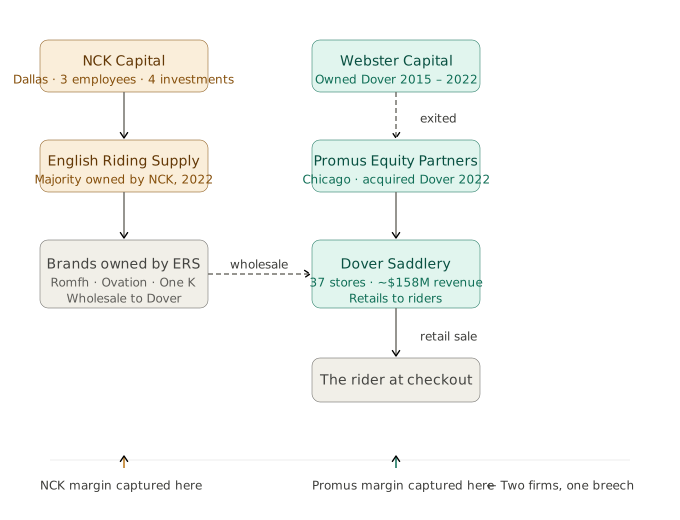
English Riding Supply (ERS) is a wholesale distributor that owns Romfh, Ovation, and One K outright. In 2022, ERS underwent a majority recapitalization backed by NCK Capital, a Dallas-based private equity firm, with PNC Mezzanine participating. NCK Capital has four total investments and three employees. ERS distributes through Dover.
So when a rider buys a Romfh breech at Dover, the transaction flows through two PE-owned entities: ERS (NCK Capital) manufactures and wholesales the product, Dover (Promus Equity) retails it. Two private equity firms capture margin on either side of a single transaction. Neither the rider nor the original brand founder is in that chain in any meaningful way.
Laura Romfh, whose name is on the breech, was listed as Founder and Head Designer at English Riding Supply following the acquisition, an employee of the PE-backed acquirer, not the owner of her brand. Her current status is unconfirmed and has not been independently verified for this article.
Tailored Sportsman sits in an adjacent position through a different mechanism. The brand is culturally dominant in the hunter/jumper ring. It appears to have no owned e-commerce website, operates through Dover and independent tack shops, and carries estimated entity revenue in the range of $500K to $1 million for a brand with outsized presence in the show ring. No PE needed: pure wholesale dependency achieves the same result. Brand equity without infrastructure. A customer relationship owned entirely by the retailer, not the brand.
Two PE firms, one transaction
When a rider buys a Romfh breech at Dover, two private equity firms capture the margin.
Not every PE story in equestrian ends with margin extraction and eroded brand equity. LeMieux is worth studying carefully precisely because it complicates the thesis.
In 2021, LDC (Lloyds Development Capital), the private equity arm of Lloyds Banking Group, took a minority stake in LeMieux. The founders retained control. LDC is patient, institutional capital with a different incentive structure than a typical buyout firm. The results speak for themselves: LeMieux grew from approximately £22 million to £59 million in revenue in four years, expanded headcount by 185%, earned a Royal Warrant, and collaborated with Stella McCartney. The brand got bigger and arguably better.
LDC/LeMieux is the counter-argument to every concern raised about Dover. Minority stake, founder control, genuine operational support, and a capital partner that understood what made the brand valuable. It is the textbook case for PE done right in consumer brands.
The structural difference is ownership structure and incentive alignment. Minority stake with founder control produces very different outcomes than majority acquisition of a distributor by a three-person Dallas firm. Both are "private equity in equestrian." They are not the same thing.
Two PE stories
LDC and LeMieux vs. Promus and Dover: the same instrument, very different outcomes.
While the incumbent retail and wholesale infrastructure has been consolidating under PE ownership, a cohort of digital-native equestrian brands has been quietly building something different.
Free Ride Equestrian and Sync Equestrian represent the alternative thesis: brands that own their customer data, their margin, and their customer relationship. They don't sell through Dover. They don't need a PE-backed distributor. They built direct-to-consumer operations, Shopify storefronts, and Instagram followings, and they are compounding. Free Ride is estimated by e-commerce analytics platforms at approximately $16 million in annual run rate. Sync at approximately $5 million. Neither figure is audited.
These are not yet threats to Dover or Ariat. But they are proof of concept. The customer is there. The demand is there. The loyalty is extraordinary: 92.6% of horse owners are female, 50% earn over $100,000 annually, and they spend an average of $11,335 per year on their horses. This is not a niche with weak customers. This is a niche with customers who have been underserved by the infrastructure built to serve them.
The brands winning the next decade of equestrian retail will not be the ones with the longest history on the Dover shelf. They will be the ones that own the customer relationship directly, understand the sport from the inside, and build community rather than just supply chains.
The US equestrian equipment market was valued at $3.8 billion in 2024. The customer base is 92.6% female, with 50% earning over $100,000 annually, spending an average of $11,335 per year per horse. This is not a niche with weak customers or thin demand. It is a niche where the infrastructure has consistently failed to match the quality of the people it serves.
State Line Tack didn't know what it had. Neither, arguably, does Dover. Someone else is about to find out.