Every tack shop owner I have talked to is doing the same math right now. Dover is closing. The customers have to go somewhere. Surely some of them land here.
The problem is that "here" assumes a total addressable market (TAM) of the people who already know you exist. That is not a market. That is a barn.
The Dover customer does not become your customer just because Dover closed. She has to find you first. And most of her has no idea you exist.
This is not a story about a shrinking market.
The US equestrian equipment and apparel market is worth approximately $5.7 billion: $3.8 billion in equipment and $1.9 billion in apparel, according to Global Market Insights. The American equestrian customer is real. She is spending. She is not going anywhere because her local Dover store closed.
She is looking for somewhere to buy. The question is whether she can find you.
A physical store is not a discovery mechanism. A Facebook page last updated in 2022 is not a discovery mechanism. Word of mouth inside a barn community reaches maybe 40 people.
This is not conjecture. It is documented.
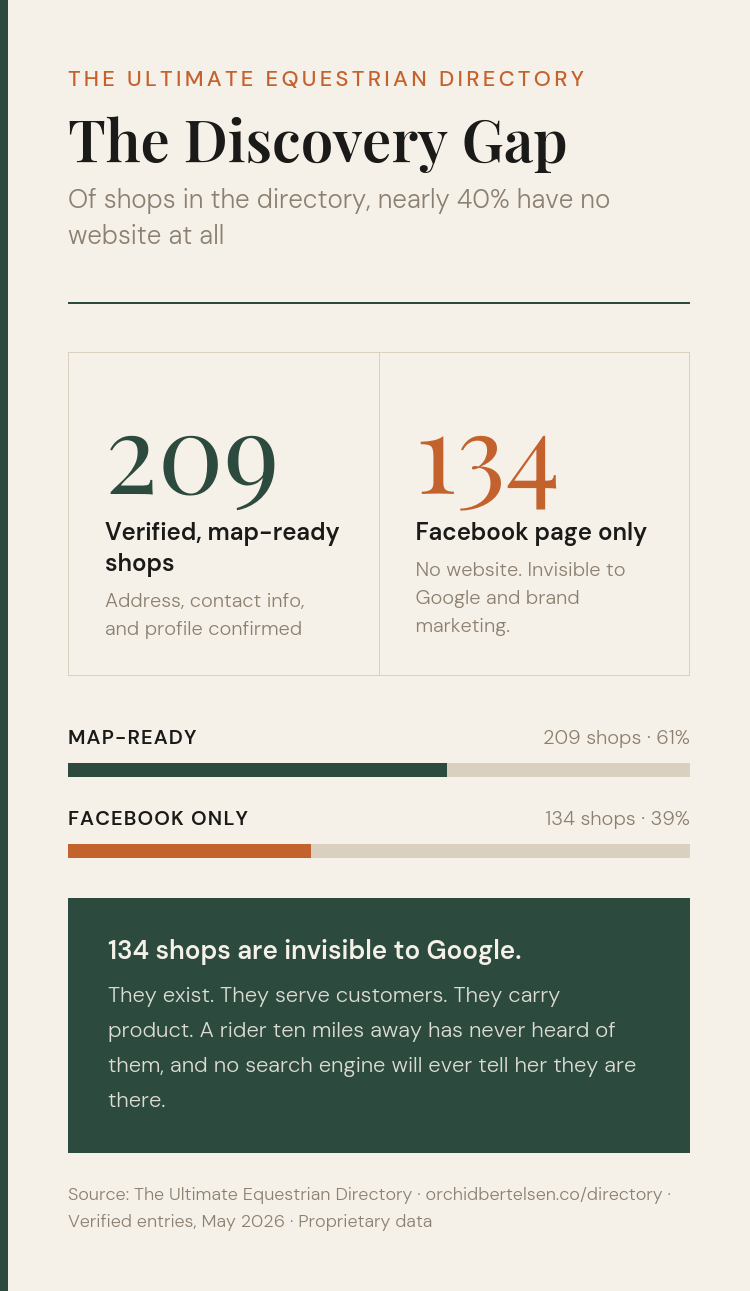
Earlier this month I launched the Ultimate Equestrian Directory, a verified database of independent tack shops and equestrian brands built specifically to address the gap Dover's closure has exposed. Of the shops currently in it, 134 have a Facebook page and no website. They are invisible to Google, invisible to brand marketing, invisible to anyone outside their immediate barn network.
Riders are finding out through the directory that a tack shop exists ten miles from them that they have never heard of. This is not an edge case. It is the norm.
The Dover customer you want is out there. She is ten miles away. She does not know you exist.
Tack shop owners are not bad at business. They are running a model that was never designed to scale discovery.
The patterns are industry-wide.
Location by proximity, not strategy. Shops open near the owner's barn, near their trainer, near their home. No trade area analysis. No horse population density mapping. A meaningful percentage of shops are in the wrong places, serving 40 local riders when there are 400 within 20 miles who have never heard of them.
Inventory by instinct, not data. No demand forecasting. No SKU-level sell-through analysis. A shop reorders by memory and gut feel. They over-buy the categories that excite them and under-buy the staples that drive velocity. Ask a shop owner what their top-selling girth size was last season. Most cannot tell you.
No markdown discipline. The resistance to a sales rack is economically irrational. Dead inventory sitting on a shelf is capital locked up at a real cost, compounding every week. The reluctance to discount feels like a matter of pride. It is a cash conversion problem.
Zero marketing beyond word of mouth. No email list. No content strategy. No paid acquisition. The addressable customer base is permanently capped by whatever the barn social network can reach.
These are not individual failures. They are industry-wide patterns that made sense when the local barn community was the entire addressable market. They do not make sense in 2026, when the largest equestrian retailer in the country just filed a WARN Act notice with the state of Massachusetts.
Here is the structural problem that rarely gets named.
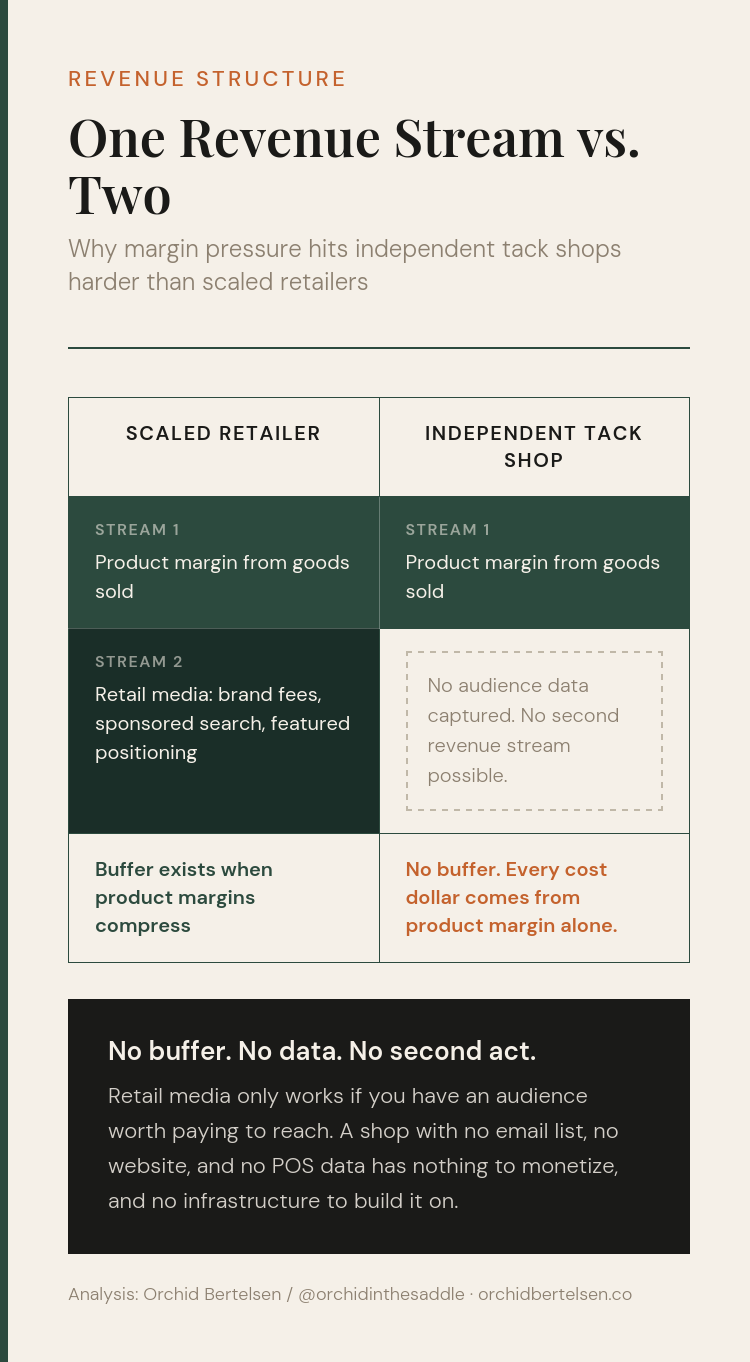
Scaled retailers have a second business running alongside the product business. Retail media: brands paying for placement, sponsored search, featured positioning, email inclusion. That revenue stream exists because the retailer has built an audience worth paying to reach. It subsidizes the operation. When margin pressure hits on the product side, there is a buffer.
Independent tack shops have none of that. Every dollar of operating cost has to be covered by product margin alone. That margin is already thin in equestrian because the category is price-transparent. A rider can find the same WeatherBeeta blanket on six sites in thirty seconds. The tack shop cannot compete on price against a warehouse operation, and there is no second revenue stream to make up the difference.
The retail media point connects to something deeper. Retail media only works if you have audience data worth monetizing. A tack shop with no POS system, no email list, and no website has no audience data at all. They could not build a retail media business even if they understood what one was, because the underlying asset, the customer relationship, was never captured.
One revenue stream. Thin margins. No data. No buffer. This is not a viability problem waiting to happen. It is a structural impossibility at scale.
None of these structural problems are permanent. They are choices, compounded over years, that can be unmade.
But they only get unmade if the owner first makes a different foundational decision: that her customer is not the 40 people at her barn. Her customer is every horse person within a 30-mile radius who has never walked through her door because they do not know she exists.
That reframe changes everything. A barn-community business has no reason to invest in Google, email, or discoverability. It already knows everyone it knows. A regional equestrian business serving an addressable market of thousands has every reason to. The TAM for an independent tack shop is not the people on her text list. It is every rider in her geography. Digital is the only way to reach them.
This is not a technology argument. It is a market size argument. The shops that survive this moment are the ones that decided their TAM was bigger than their barn.
The model of what a digitally capable equestrian retailer looks like is not hypothetical. It exists, and it has been running for decades.
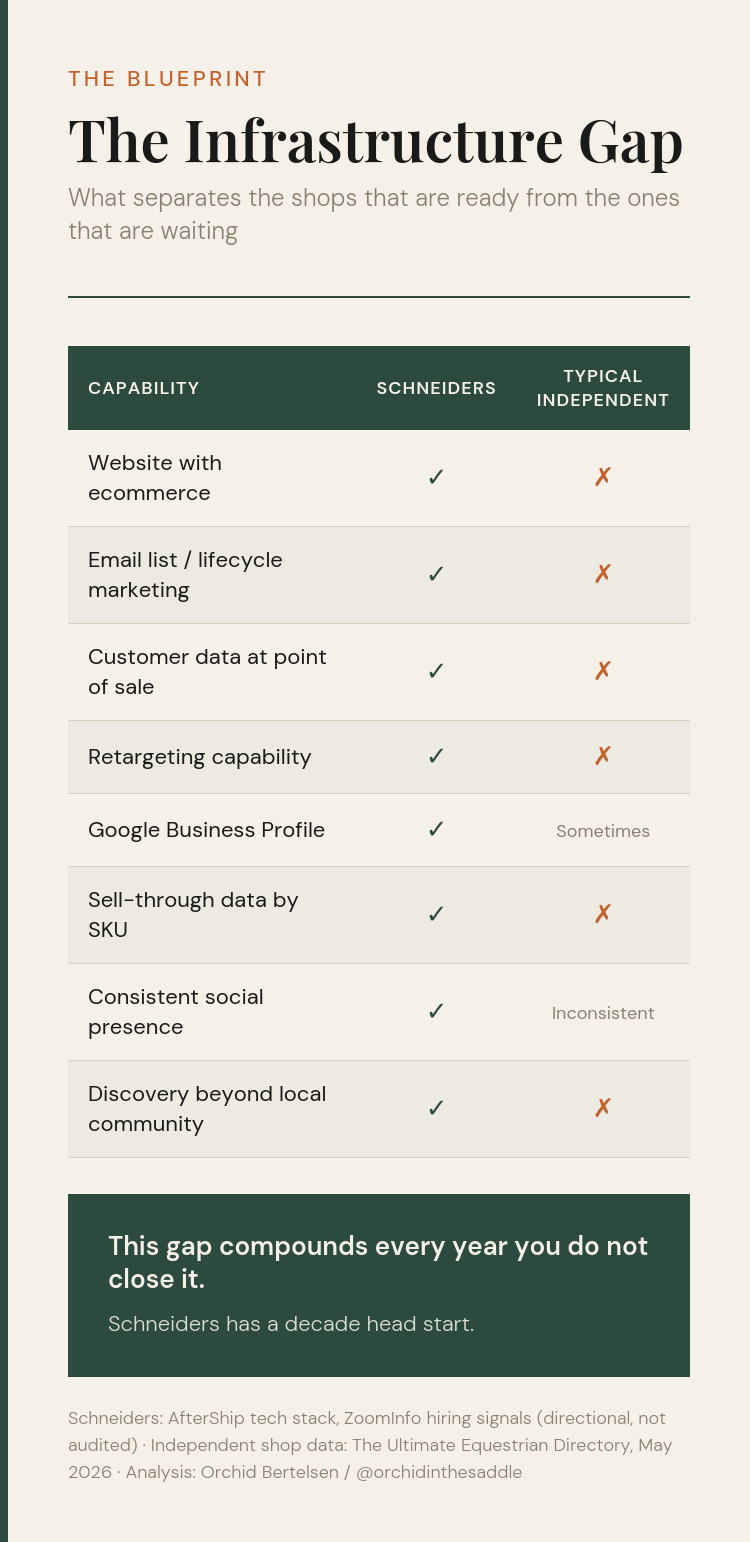
Schneider Saddlery, founded in 1948 in Chagrin Falls, Ohio, is a third-generation family business doing approximately $26 million in annual revenue, according to B2B data providers. (Revenue figures from commercial data aggregators are not audited accounts and should be treated as directional.) Their ecommerce operation runs 19 software tools across analytics, CRM, retargeting, lifecycle email, and cross-border commerce. They are actively hiring for roles requiring TikTok experience, A/B testing, conversion rate optimization, and Shopify.
This is not a shop that decided to go digital after Dover closed. They built the infrastructure over years. The Dover moment did not create their opportunity. It found them already ready.
Schneiders is not a typical independent tack shop. They are a catalog-native, ecommerce-first multi-channel retailer that happens to have roots in the same community as the shops in this article. But that is precisely the point. The blueprint exists. It has been proven at scale inside the equestrian category. The gap between Schneiders and the 134 Facebook-only shops in the Ultimate Equestrian Directory is not a mystery. It is a decade of compounding investment in customer data, owned channels, and digital discoverability.
The lesson is not that every tack shop needs to become Schneiders. It is that the shops capturing Dover customers right now built something before they needed it. The ones waiting for the phone to ring are going to be waiting a long time.
The Dover customer exists. She is spending. She is looking for somewhere to buy in a $5.7 billion market, and the largest single retailer in it is in liquidation.
An email list is the single highest-leverage thing a tack shop can build right now. It is the one channel that does not depend on an algorithm, does not require a paid ad budget, and cannot be taken away when a platform changes its rules. Every customer who walks through the door is an email address that is not being captured.
After that: a complete and current Google Business Profile. A website, even a simple one. A listing in the Ultimate Equestrian Directory so that when a rider searches for a tack shop in your area, you show up. Submission is free.
None of this is technically difficult. All of it requires deciding that the customer outside your barn network is worth going to get.
The demand is real. Your TAM is not your barn. Go get it.