While US equestrian retail spent decades consolidating, fragmenting, and arguing about who was left standing, Canada built something more durable. Greenhawk Equestrian Sport has operated as that country's dominant equestrian retailer since 1985. Over 50 locations, a national franchise network, a catalog business, an international e-commerce platform, and a pet store chain acquired as a strategic adjacency. They built, in short, what US equestrian retail has never produced.
Now they are coming here. And what they are about to find out is whether what worked in Canada translates to the United States, and whether the US equestrian community is ready to meet them on their terms.
Those are genuinely open questions.
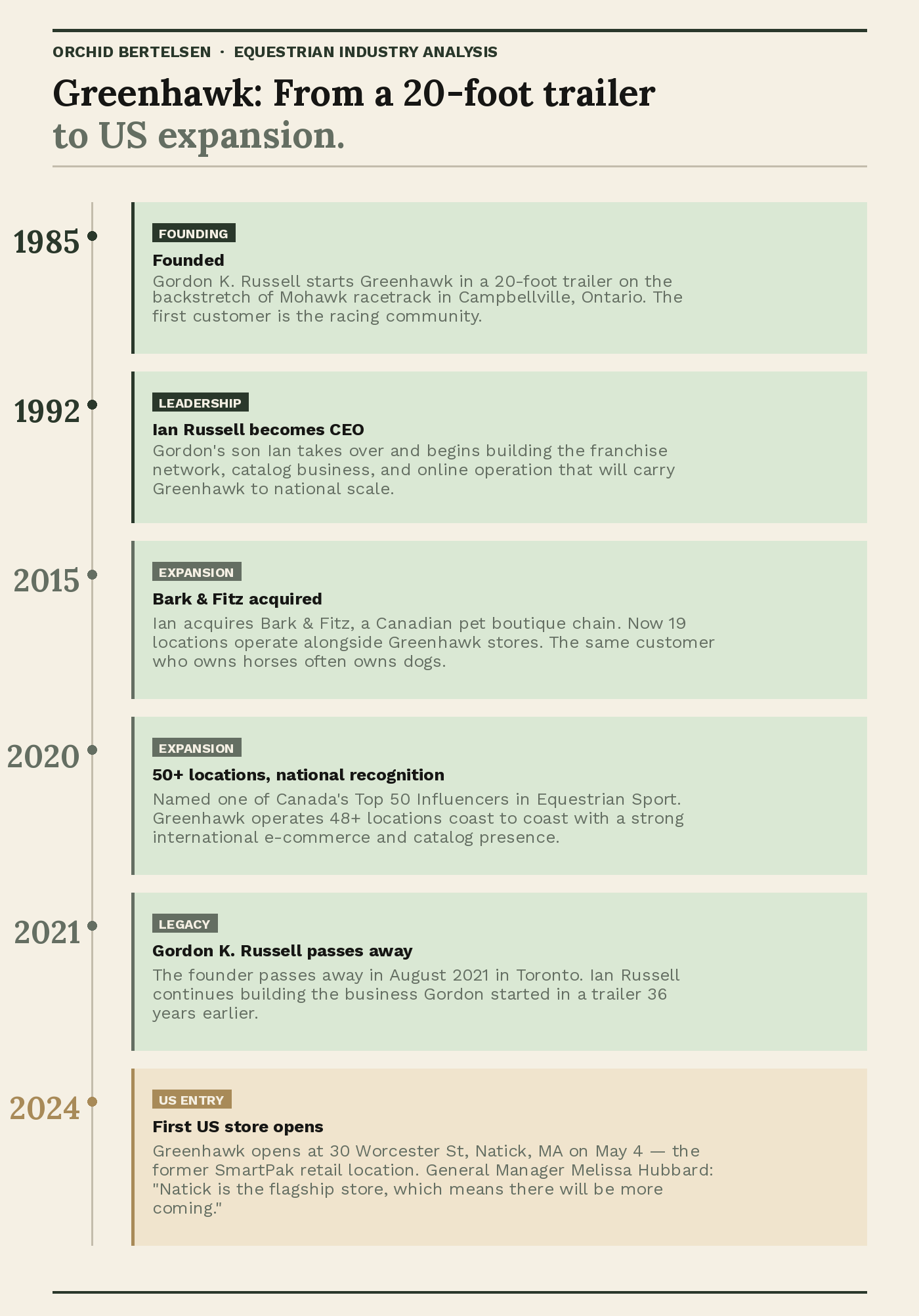
Greenhawk started in 1985 in a 20-foot trailer on the backstretch of Mohawk racetrack in Campbellville, Ontario. The customer at the time was not a hunter/jumper competitor or a dressage enthusiast. It was the racing community: grooms, trainers, and backstretch workers who needed product and needed it close. Gordon K. Russell understood that proximity and reliability mattered more than selection at that scale.
That original insight, go where the horse people are and make it easy to buy, became the operating principle that Greenhawk has run on for four decades.
Gordon's son Ian joined the company and took over as CEO in 1992. What Ian inherited was a handful of corporate stores. What he built was a franchise network, a catalog business, and an international e-commerce operation. The growth from backstretch trailer to Canada's largest equestrian retailer happened under his watch, without private equity, without an IPO, and without selling the family out of the business.
As of 2020, Gordon was still coming into the office every day at 82. He passed away in August 2021. His Globe and Mail obituary remembered him as someone who "led a life of love, adventure and tenacity" and noted that Greenhawk was among the many ventures he launched and loved. The business he started in a trailer on a racetrack is now run by his son and has over 50 locations. That kind of founder continuity, even after the founder is gone, is not incidental. It is a structural advantage that most retail operators in this category have never had.
The franchise model is what made the scale possible. Greenhawk explicitly recruits equestrian community members as franchise owners: individuals with strong equestrian experience who want a career in the horse industry, partnered with a proven operational system. That is a meaningfully different approach than hiring retail generalists. The person running the store usually rides.
The catalog and e-commerce operation extended the reach beyond physical footprint. Ian Russell is credited with building both, and Greenhawk now operates an international e-commerce platform alongside its retail network. A rider in a province without a nearby Greenhawk store has been able to buy from the catalog for decades.
In 2015, Ian made a move that most equestrian retailers would not have considered: he acquired Bark & Fitz, a Canadian pet store chain, which now operates 19 boutique locations across Canada. Bark & Fitz locations can be found inside select Greenhawk stores and as standalone locations. Ian's brother Jon serves as Business Development Manager for the brand. The pet and equestrian adjacency is not as unusual as it sounds: the same customer who owns horses often owns dogs, and the supply chain, vendor relationships, and retail infrastructure overlap more than they diverge.
What Greenhawk built in Canada is a multi-brand, multi-channel, multi-discipline retail operator that compounds. The franchise model grows the store count without requiring corporate capital for every location. The catalog and e-commerce extend revenue beyond geography. The pet adjacency diversifies the customer base. These are not accidents. They are a system.
The positioning distinction that matters most for understanding Greenhawk's US relevance is this: they serve all disciplines. Hunter, jumper, dressage, standardbred racing, thoroughbred racing, driving, western, pleasure. That is not how Dover Saddlery has historically positioned itself, and it is not how most US equestrian retailers think about their customer.
A Greenhawk store is not a hunter/jumper shop that also stocks a few western items. It is a retailer built for the horse person across disciplines, which means it can serve a wider customer base in any given market than a discipline-specific competitor can.
Greenhawk also features product lines from over 40 Canadian entrepreneurs, including brands not widely available in the United States. That gives the retail experience a curation dimension that a purely brand-aggregator model does not have.
In early 2024, SmartPak announced it was closing its Natick, Massachusetts retail store at 30 Worcester Street. SmartPak had operated the location for nearly 20 years. When the space became available, Greenhawk moved immediately.
Hubbard's hire itself was a signal. Her background spans over 20 years in the US equine industry, including SmartPak, EquiFit, and Kerrits. She was among the first ten employees at SmartPak. "I was on the team of people at SmartPak that opened their retail store at this same location in Natick 19 years ago," she told The Plaid Horse. That is not a coincidence. Greenhawk hired someone who understood the specific customer at the specific location they were entering.
The renovation was not a light refresh. Greenhawk received keys to the space on March 15, 2024, and immediately began a full overhaul: new exterior signage, repaved and reconfigured parking lot, new landscaping, outdoor seating, and a complete interior renovation. The resulting store is nearly 10,000 square feet. The grand opening was May 4, 2024.
Hubbard's mandate is not to run one store. "My role is to get Natick up and running and then expand the business beyond that," she told The Plaid Horse. "Natick is the flagship store, which means there will be more coming."
New England is the right beachhead. The density of English discipline riders in Massachusetts, Connecticut, and Vermont is the highest concentration in the United States. The horse communities around Natick and the broader MetroWest area have been buying equestrian product from catalog and online retailers for decades because the physical retail options have been thin. Greenhawk placed their first store inside that gap.
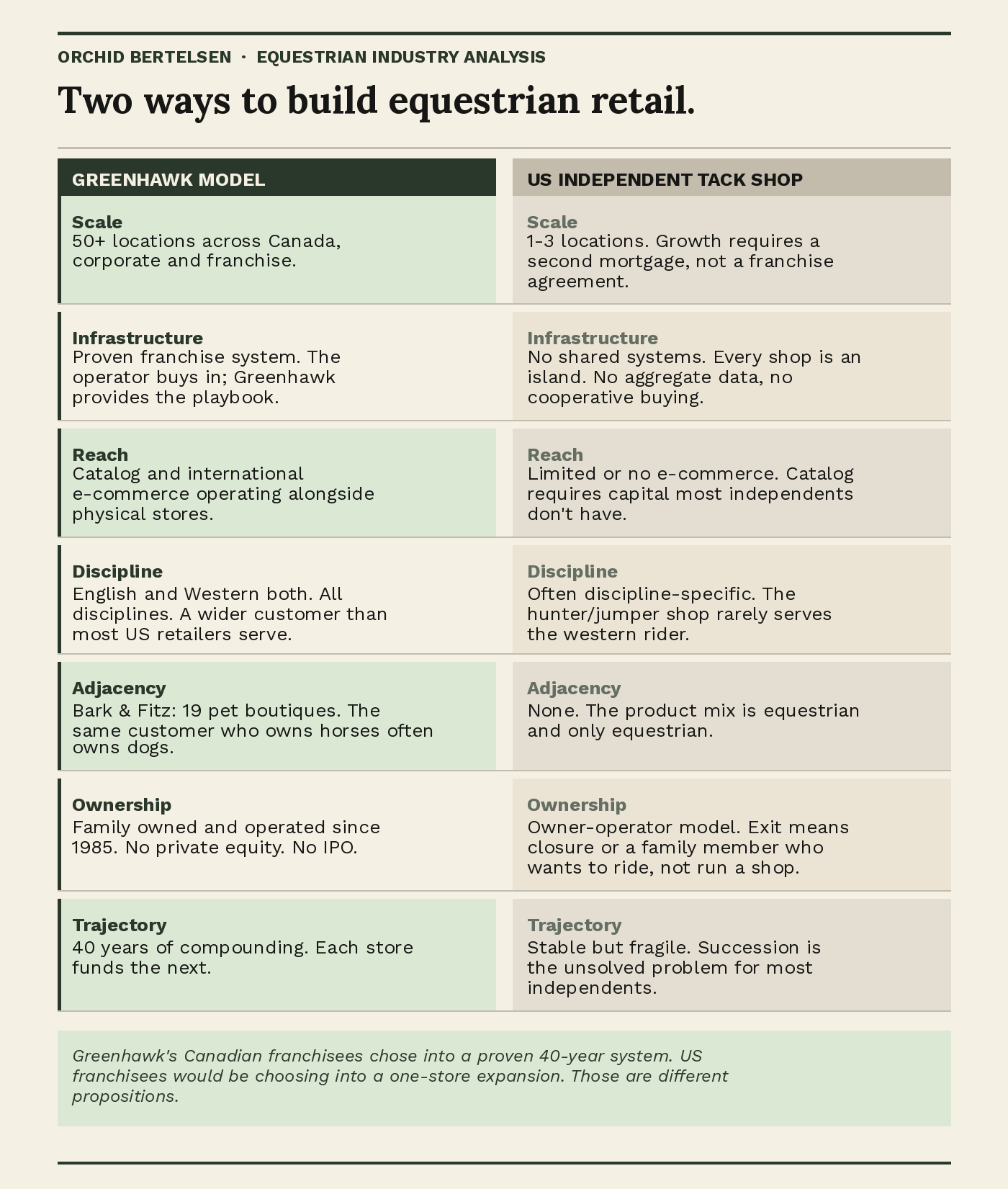
The franchise model is the growth engine. It is how Greenhawk built 50+ locations across Canada without capitalizing every store from the corporate balance sheet. Recruiting equestrian community members as franchisees in new US markets is the logical playbook extension. The question is whether US equestrian operators, who have historically operated as independent tack shop owners, will trade independent ownership for a franchise relationship with a Canadian parent.
That is genuinely unknown. Greenhawk's Canadian franchisees chose into a proven, established system. US market entrants would be choosing into an expansion with one operational store. Those are different propositions.
What Greenhawk brings to the US that no domestic competitor has assembled is 40 years of multi-store equestrian retail experience, a franchise infrastructure that has already proven it can scale, and a cross-discipline positioning that gives them a wider addressable customer than a discipline-specific competitor. What they are finding out now is whether the US equestrian customer is ready to meet them, and whether the US equestrian business community is ready to partner with them.
The Canadian answer, over four decades, has been yes.