The equestrian brand that wins the adult amateur equestrian first will earn a customer the rest of the industry is still ignoring. Part 1 made the personal case. Part 2 made the market case. This one answers the practical question: if the adult amateur equestrian is the industry's most underserved and commercially attractive customer, what would a brand actually have to do to win her?
This is not a theoretical exercise. It is a specific playbook, grounded in what this customer is, what she wants, and what the brands currently failing her have in common. The opportunity is real. The execution is not complicated. What is missing, almost universally, is the decision to try.
The Starting Point
Start By Understanding What She Has Already Decided
The adult amateur equestrian returning to the sport has already made the most consequential decision: she is back, she is committed, and she has carved time out of a very full life to be here. She is not in a consideration phase. She is in an execution phase.
This matters for how a brand should think about reaching her. She is not browsing. She is buying with purpose. She has a list. She knows what she needs. And because the industry has not served her well, she has learned to do her own research, read reviews carefully, and trust peer recommendations over brand advertising.
The brand that shows up as a credible, knowledgeable voice before she has made her decisions does not have to compete. It becomes the reference point she uses to evaluate everything else.
That is the position every equestrian brand should want with this customer. Almost none of them have it.
The Four Requirements
The Four Things She Actually Needs From a Brand
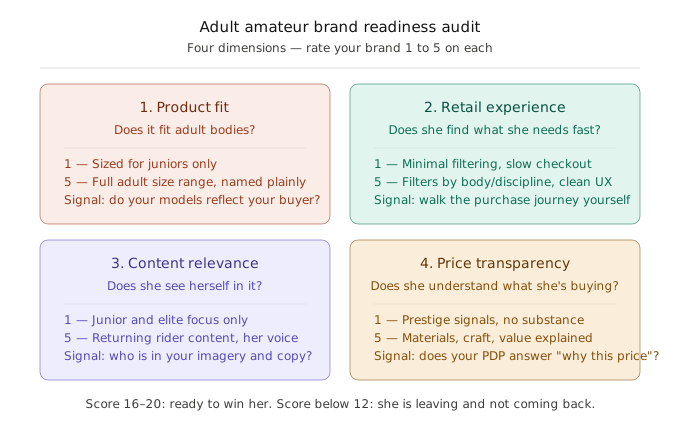
Rate your brand 1 to 5 on each dimension. Score 16 to 20: ready to win her. Below 12: she is leaving and not coming back.
Based on what the data tells us about this customer and what she consistently describes as missing, the adult amateur's requirements from an equestrian brand fall into four categories. None of them are complicated. All of them are underdelivered.
1. Products designed for her body, not a junior's. This is the most concrete and most fixable gap. The adult amateur has a body shaped by time, not riding. She may have had two children. She has spent a decade at a desk. She is not asking for flattery. She is asking for breeches that function, show coats that close, and boots that accommodate a calf shaped by something other than adolescence.
The brands that address this directly, naming it plainly in product descriptions and sizing guidance, will earn immediate loyalty from a customer who has been quietly frustrated by this for years. The brands that continue to photograph their equestrian apparel exclusively on riders who are 22 years old and a size four will continue to lose her at the product page. Sizing transparency is not a concession. It is a competitive advantage with this specific customer.
2. A retail experience that respects how she shops. The adult amateur is an experienced online consumer. She comparison shops. She reads specifications. She expects to be able to filter by the attributes that matter to her specific body and discipline. She abandons carts when the experience is unclear, slow, or makes her work too hard to find what she needs.
Equestrian e-commerce, with very few exceptions, is built for a customer who is either brand-loyal to the point of not needing to search, or patient enough to browse without a specific outcome in mind. The adult amateur is neither. She is outcome-oriented and time-constrained. The fix is not expensive. It requires someone to walk the purchase journey as this customer and ask, honestly, whether the experience is worthy of what she is about to spend.
3. Content that treats her as an athlete with a context, not a beginner with a horse. The adult amateur is not a beginner. She may be returning after years away, which means she has gaps in her current knowledge, but she has a foundation, an instinct, and a deep emotional relationship with horses that no beginner has. She does not need to be told which end of the horse to approach.
What she needs is content that acknowledges both things simultaneously: that she is capable and experienced, and that returning to riding after a long break involves specific challenges she will not find addressed anywhere else. That content does not exist at scale in this industry. The brand that creates it does not just sell a product. It becomes a resource this customer returns to repeatedly, recommends to everyone she knows, and associates with understanding her in a way nothing else has.
4. Honesty about price and value. The adult amateur has been managing household budgets, making significant financial decisions, and evaluating value propositions professionally for twenty years. She can tell immediately when a brand is marketing price and value dishonestly.
What she wants is straightforward: tell her what the product is, tell her what it does, tell her why it costs what it costs, and let her decide. She is willing to spend at the premium tier. She is not willing to be sold at the premium tier with mid-tier reasoning. Brands that are transparent about their materials, manufacturing, and what the price actually reflects earn disproportionate trust with this customer. Brands that rely on prestige signaling without substance lose her permanently after the first disappointing purchase.
The Channel Strategy
The Channel Strategy That Actually Reaches Her
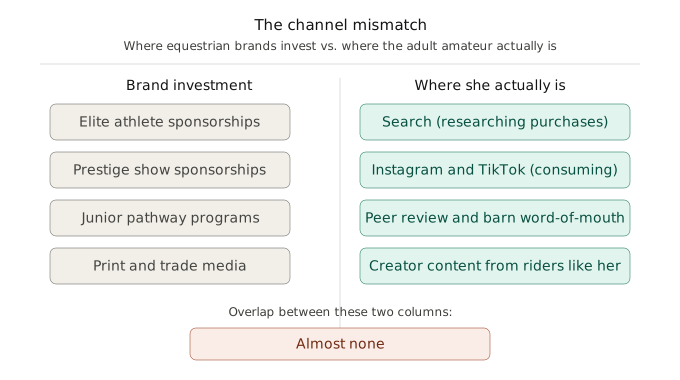
Where brands invest vs. where she actually is. Overlap between these two columns: almost none.
Knowing what the adult amateur needs is only half the problem. The other half is reaching her, because she is not findable through the channels equestrian brands have traditionally invested in.
She is not at the junior shows where brand visibility has historically been concentrated. She is not reliably watching elite sport coverage. She is not embedded in the traditional equestrian media ecosystem that has served as the industry's primary advertising channel for decades.
She is, however, online. She is active on Instagram and TikTok, though she consumes rather than posts. She reads product reviews with unusual care. She participates in barn community conversations that happen informally but efficiently. She uses Google to research purchases the same way she researches everything else in her professional and personal life.
This means the brands that reach her are the ones investing in: search-optimized content that answers the specific questions she is asking, social content that reflects her actual experience rather than an aspirational version of the sport she does not recognize, and peer review infrastructure that lets her hear from riders who are like her.
The creator economy is directly relevant here. Deloitte research cited in equestrian industry analysis suggests that businesses integrating creator-generated content see 20 to 30% higher engagement than those relying on polished corporate assets. For the adult amateur specifically, creator content from riders who share her profile, returning adults, working parents, self-funders, people who are genuinely figuring it out, is the most credible content a brand can associate with. It is also the content this customer is actively looking for and not finding.
The brands that partner with creators who authentically represent this customer are not just buying reach. They are accessing a trust relationship that no amount of event sponsorship can replicate.
The Junior Investment Logic
What the Junior Investment Logic Gets Wrong
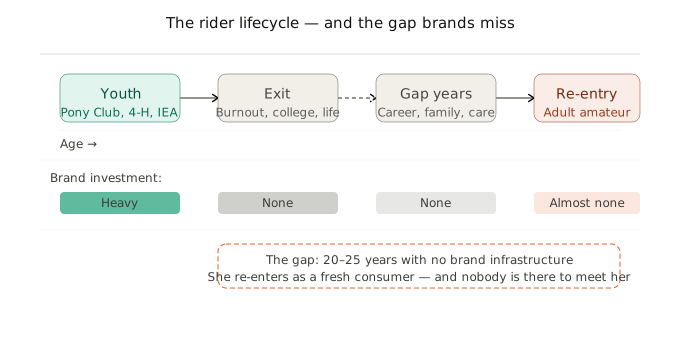
The gap: 20 to 25 years with no brand infrastructure. She re-enters as a fresh consumer, and nobody is there to meet her.
The equestrian industry's marketing infrastructure has been built around a specific thesis: invest in junior riders, and you build brand loyalty that persists for decades. It is a reasonable thesis. It is also incomplete.
It works when the junior stays in the sport. A large share of them do not. And when they return as adults, the brand relationships they formed at 14 are largely dormant. They are re-entering as fresh consumers, with adult expectations and adult budgets, and they are making new decisions about who earns their business.
The industry is treating this re-entry moment as if it does not exist. There is no marketing infrastructure oriented toward the returning rider. There is no onboarding content designed for someone who rides like an intermediate but shops like a first-time customer because she has been away for twenty years. There is no acknowledgment, from almost any brand, that this customer exists at all.
That is a significant and compounding error. The cohort of riders in their late thirties, forties, and fifties who are returning to the sport is large, is growing, and is making brand decisions right now. The brand that shows up for that moment does not just make a sale. It earns a relationship with a customer who has twenty-plus years of spending ahead of her.
The Economics
Loyalty Economics: Why This Customer Is Worth More Than She Appears
Estimated 5-year brand value: $15–30K for a junior customer vs. $90–150K for a returning adult amateur. Illustrative model.
Standard customer acquisition logic focuses on the first purchase. For the adult amateur, that framing dramatically undervalues the opportunity.
Retention economics are well established across industries: a 5% improvement in customer retention can increase profit by 25 to 95%, because retained customers buy more, buy more often, and cost significantly less to maintain than new customers cost to acquire. The adult amateur who becomes a loyal customer of a brand is not a one-time transactor. She is a multi-year, high-value, low-churn revenue stream.
And she is a multiplier. Consumer loyalty research in the equestrian space consistently identifies word of mouth and peer recommendation as the primary influences on purchasing decisions. The adult amateur is embedded in a barn community that talks. When she finds a brand that fits, she tells people. When she does not, she also tells people. The acquisition value of winning her is not just her own spending. It is the downstream spending of everyone she influences.
The brands currently investing primarily in junior acquisition are buying a customer who may or may not persist in the sport, whose purchasing authority is limited by parental gatekeeping, and who will make new brand decisions when she returns as an adult anyway. The brands investing in adult amateur acquisition are buying a customer who is already committed, already spending, and already embedded in a network of similarly high-value peers.
The math is not difficult. The decision, apparently, is.
Where to Start
The Entry Point Does Not Require a Complete Repositioning
For a brand that has not historically invested in the adult amateur, the entry point does not need to be a complete repositioning. It needs to be a credible signal that she has been noticed.
That signal can take several forms. A sizing guide written specifically for adult bodies, with language that acknowledges the reality of what those bodies look like, is a start. A content series that addresses the returning rider experience directly, without condescension and without pretending the gap years did not happen, is a start. A single product page that answers the questions this customer actually arrives with, rather than the questions a junior might have, is a start.
None of these require a brand to abandon its existing customer relationships or its core identity. They require a brand to expand its peripheral vision to include a customer who is already in the sport, already spending, and already waiting for someone to acknowledge she is there.
The adult amateur equestrian is not asking to be the center of the industry. She is asking to be seen by it.
The brands that see her first will earn something the industry's current marketing infrastructure cannot buy: her trust, her spending, and her voice.
This is Part 3 of a three-part series on the adult amateur as the equestrian industry's most underserved customer. Part 1 is the personal argument. Part 2 is the market data.